By Ar. Wooi Lok Kuang, Wooi Architect. Adapted from a guest lecture at Future Thinker XX, Taylor's University, on the theme "Conscious Horizon".
_____
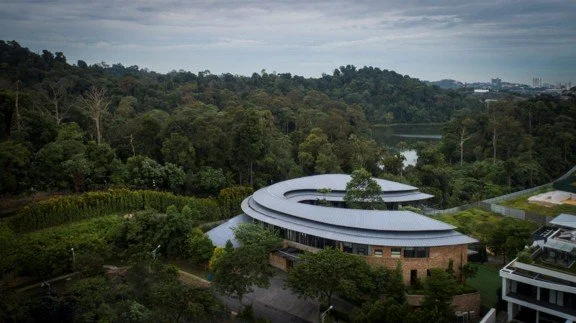
YeYuen House, Setia Eco Park, at the edge of the forest
The organisers of Future Thinker XX described architecture as "an invisible authority whose spatial geometry silently scripts human behaviour, subconscious thought and social dynamics." It is a powerful idea, and I want to take it seriously. I also want to complicate it a little.
The First Horizon
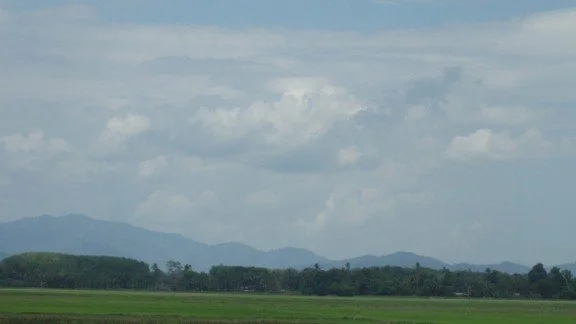
Paddy fields at Tanah Merah, Pendang, Kedah
I grew up in Tanah Merah, in Pendang, Kedah, among Malay villages and paddy fields, helping my father in his small sundry shop. The landscape was flat, green and wide open to the sky.
Nobody designed that horizon, and yet it governed everything. It told the farmers when to plant. It told us where the afternoon wind would come from, when the rain was coming, and where to sit when the sun was high. The kampung houses along its edge, raised on stilts, open to the breeze and shaded by deep roofs, obeyed it without anyone writing a rule.
Literally, a horizon is the limit of what we can see. Phenomenologists, beginning with Edmund Husserl, gave the word another meaning: the background of everything we perceive without quite attending to it, the halo around our attention. That is exactly where architecture does its work. We rarely look at architecture directly. We live in its horizon, and it shapes us from the edge of our awareness. So the question is simple: what does architecture do at that edge? Does it keep things hidden there, or does it bring them into view?
Architecture Governs
The theme has a famous ancestor. On 10 May 1941 a bomb destroyed the chamber of the House of Commons. On 28 October 1943 Winston Churchill rose to propose how it should be rebuilt, and said: "We shape our buildings and afterwards our buildings shape us."
What is less often remembered is why he said it. Churchill insisted on the old oblong chamber rather than a semicircle. In a semicircle, he argued, a member could drift from left to right "by insensible gradations". In an oblong, with the two sides facing each other, crossing the floor is a visible act. He also insisted that the chamber be too small to seat every member at once, because a half-empty hall makes debate feel dead and a crowded one makes it feel urgent.
That is geometry scripting politics: the shape of a room setting the temperature of a nation's arguments. The theme is right. Architecture is an authority. The question is not whether it governs, but how, and towards what.
A Darker History
Authority that works invisibly has a darker history. In 1791 Jeremy Bentham published his Panopticon: a ring of cells around a central inspection tower. The prisoners could always be seen but never knew when they were being watched, so they learned to watch themselves. Geometry replaced the guard. In 1975 Michel Foucault, in Discipline and Punish, made the Panopticon the model of modern power, power that needs no chains, only arrangement. "Visibility," he wrote, "is a trap."
Closer to everyday life is the shopping mall. Victor Gruen imagined the mall as a civic centre for the suburbs. What was often built instead were interiors designed to disorient, with no clocks, no windows and no clear way out, so that shoppers forget why they came. That moment of forgetting came to be called the Gruen transfer. Gruen himself was appalled, and in a 1978 speech in London he disowned these developments.
Today we can add newer forms: the bench designed so that no one can lie on it, the sealed tower that never lets you feel the weather, the smart building that quietly learns your habits. All of them work the same way. They operate below the horizon of our awareness, and they work best when we do not notice them.
Two Directions of Invisible Authority
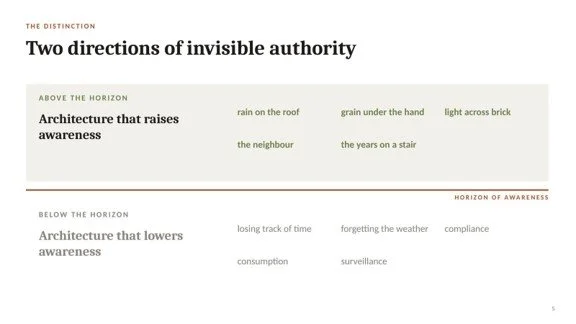
Two directions of invisible authority: above and below the horizon of awareness
Imagine a horizon line drawn across any building: the line of our awareness. Some architecture pushes experience below that line. You lose track of time, forget the weather, stop noticing other people. You comply, you consume, you follow the path that has been set for you. The building governs you precisely by keeping you unconscious.
Other architecture does the opposite. It pulls the world above the line. It makes you notice the rain on the roof, the grain of timber under your hand, light moving across a brick wall, the neighbour in the courtyard, the years accumulating on a staircase.
Both are invisible authorities. But only one of them leaves people more conscious than it found them. That, I believe, is the real conscious horizon: a line architecture can either push people beneath or help them rise above.
Architecture Cannot Escape Authority
Here is my proposition. Architecture cannot escape authority. Every wall, every stair, every threshold is already a kind of instruction. It can only choose its kind: an authority that hides, or an authority that reveals.
The nuance matters. Good architects do script. A courtyard scripts gathering; a staircase scripts a pause. The difference is not between control and freedom, which would be naive. It is between an instruction and an invitation. An instruction must be obeyed, and it works best when it goes unnoticed. An invitation can be read, and it can be declined. It respects the person who receives it.
A second question follows. If architecture must exercise authority, whose should it be? The architect's ego? The developer's spreadsheet? Or something older and wiser? For me, it has always been the authority of the place itself.
Authority Borrowed from the Place
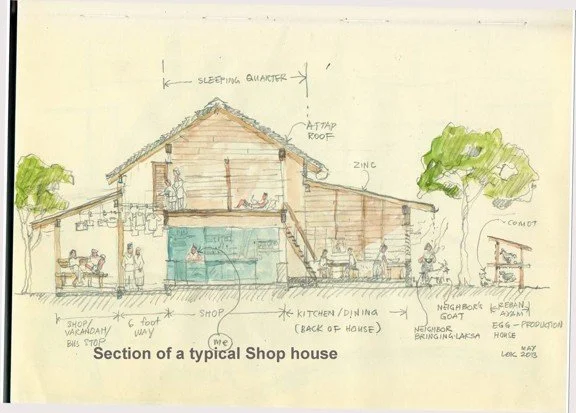
Sketch: section of a typical shophouse
Around the year 817, the Tang poet Bai Juyi built himself a thatched hall on Mount Lu. In his record of it, he describes placing the door to the north to catch cool breezes and fend off the heat, raising the southern rafter to admit winter sun, and leaving the beams unpainted and the walls without a final coat of white. He obeys the wind, the sun and the season, and he practises restraint.
Our own Malay house works the same way. It is raised on stilts against flood and damp, with steep roofs that shed the rain and low windows that bring the breeze to people sitting on the floor. Lim Jee Yuan documented it in 1987 as a complete shelter system. Traditional carpenters measured with the body itself, the depa, the hasta and the jengkal, so the house was literally proportioned to the people who lived in it. Our shophouses carry the same intelligence: ventilation, shade, and a gradual passage from street to home.
None of this was designed by a single authority. It was accumulated. That accumulated wisdom is what I call Tropical Intelligence. By this I do not mean artificial intelligence, sensors or smart buildings. I mean the wisdom embedded in the tropics themselves: in materials, climate, patterns of dwelling, craftsmanship and place. The architect does not invent this intelligence. The architect recognises it, interprets it and gives it form. Architecture becomes less an act of imposition and more an act of listening.
Since I founded Wooi Architect in 1996, six forms of this intelligence have emerged through our projects: Matter, Climate, Space, Culture, Time and Place. Each is a way of moving something across the horizon, out of the unconscious and into awareness.
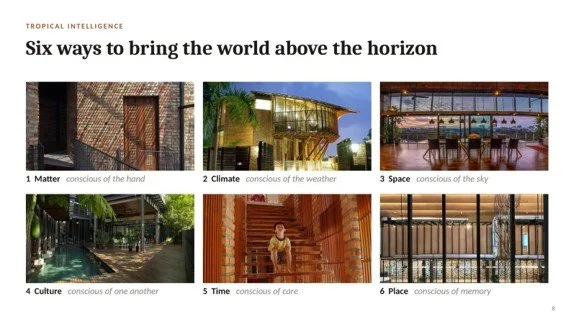
The six intelligences: matter, climate, space, culture, time and place
Matter: Conscious of the Hand
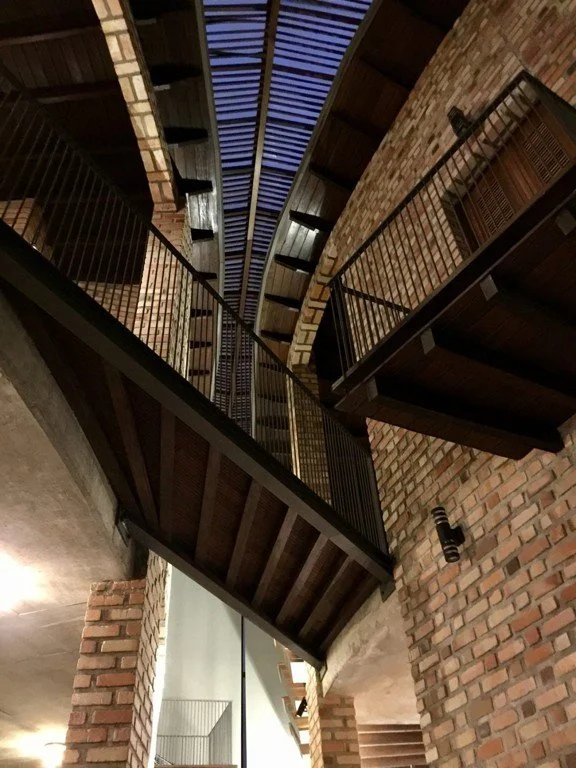
House 9, Setia Eco Park: exposed brick under a continuous skylight
Architecture begins not with form, but with matter. At House 9 in Setia Eco Park, the brick walls are not hidden behind plaster. They are structure, enclosure, environmental filter and texture all at once. A continuous skylight lets daylight travel across the brick through the day, and at night it frames the stars.
Concealment is where invisible authority hides. When a building is clad and plastered until you cannot tell how it stands, it simply asks you to trust it. When structure is exposed, the building shows you how it stands, and its authority becomes legible. Honesty is ethical before it is aesthetic.
Materials reveal their intelligence only through the hands that understand them. The master builder of House 9 was the late Mr Woong, who passed away during the COVID pandemic. His knowledge of bricklaying, of proportion and of how mortar behaves in our humidity could never be fully captured in drawings. House 9 belongs as much to the hands that laid each brick as to the mind that imagined it.
Climate: Conscious of the Weather
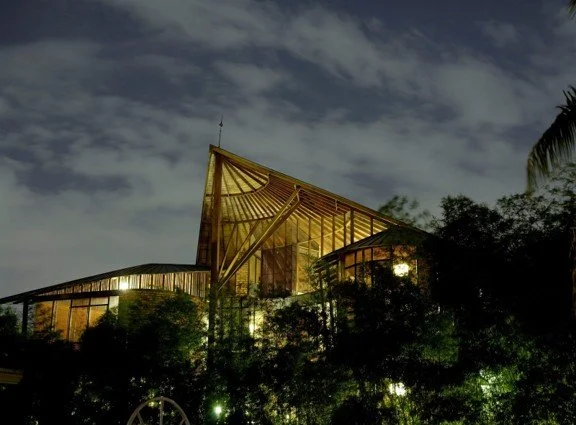
Wooi Residence, Shah Alam: the sailing roof at dusk
If matter teaches us how to build, climate teaches us how to live. The tropics are too often treated as a problem to be solved by sealing, cooling and excluding. I believe they are a teacher to learn from.
My own home, Wooi Residence in Shah Alam, was completed in 2003. Its large sailing roof works like a rainforest canopy, creating a microclimate beneath it. It tempers the sun into shade, receives the rain and guides the wind through the house, and most of the house lives without air-conditioning. Between inside and outside there is no hard line, only layers: verandas, terraces, shaded edges and timber screens.
A sealed, air-conditioned box also scripts behaviour: it teaches us to forget where we are. This roof does the opposite. When it rains, you hear it; when the wind turns, you feel it. The roof does not protect us from the tropics. It teaches us how to live beneath their sky.
Space: Conscious of the Sky
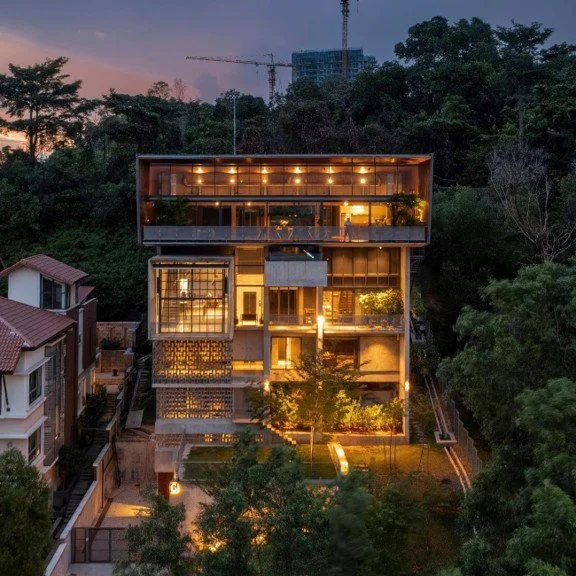
Oculus House, Seputih Heights
Spatial intelligence is not efficient planning or circulation. It is architecture's capacity to organise human experience before it organises human activity.
At Oculus House, on a steep hillside at Seputih Heights and a PAM Gold Award winner in 2023, the oculus is not a formal gesture but an instrument. It edits the sky, frames the clouds, measures the movement of the sun, reveals rain as an event and turns light into a material. A city dweller can go a week without truly looking at the sky. The oculus instructs no one to look up. It simply makes the sky impossible to ignore.
Space: Conscious of Possibility
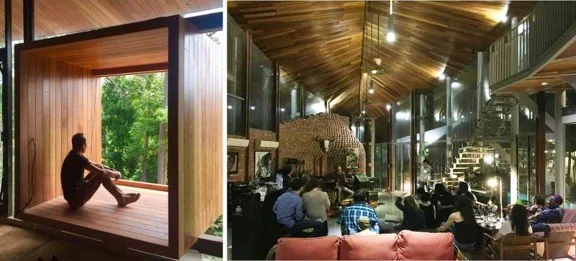
Left: a timber window seat at YeYuen House. Right: one hall, many gatherings at Muddy Delta
Space can also be possibility. YeYuen House in Setia Eco Park curves around its garden beside the lake park. Families change; children grow up and leave; new rituals arrive. Architecture cannot predict these changes, but it can prepare for them. A deep timber window becomes a seat, a lookout, a place to be alone. The task is not to anticipate every activity, but to create spaces capable of receiving lives that have not yet unfolded.
At Muddy Delta we explored what I call co-spatiality: the capacity of one space to support many scales of gathering without changing its identity. The same hall expands for lectures and celebrations and contracts around an intimate conversation, through proportion, threshold and atmosphere rather than movable walls. A good script leaves room for the actors: permission, not prescription.
Culture: Conscious of One Another
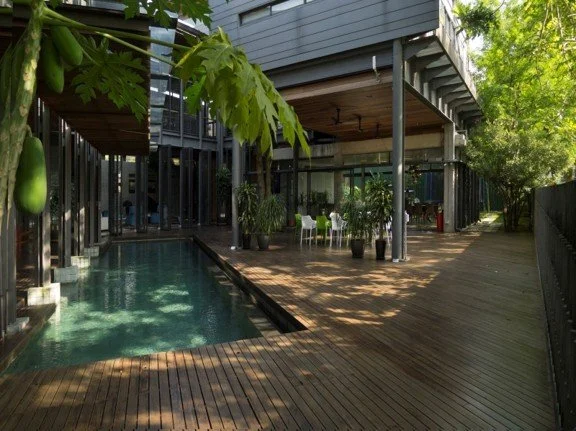
Heng House, Tropicana: pavilions around a shared courtyard
Culture is often mistaken for style: the traditional roof, the ornament, the familiar motif. Those are only the surface. Culture is accumulated knowledge about living together.
Heng House in Tropicana, a PAM Gold Award winner in 2018, is a series of pavilions around a shared courtyard. The pavilions protect individuality; the courtyard protects community. Morning conversations, children's play, family meals and quiet moments all unfold around the same centre. The architecture does not instruct anyone to gather. There is no sign, no programme, no rule. It simply makes gathering natural. The most important room in the house has no walls, no roof and no programme, yet it gives meaning to every other room.
Time: Conscious of Care
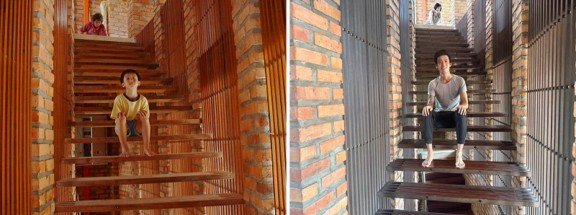
The same Chengal staircase, 2003 and 2026
Buildings are judged on the day they are completed, but architecture belongs to decades. Two photographs taken on the same Chengal staircase in my house show my son as a child in 2003 and as a grown man in 2026. The child has changed completely. The staircase has quietly carried on.
Chengal does not resist ageing; it records it. Weathering enriches rather than diminishes, and maintenance becomes stewardship rather than burden. Every building has two architects: the one who designs it, and time itself. Much of what we build is designed to look new forever, and so it looks old very quickly. A building that ages honestly lets its inhabitants see their own lives in it. The true measure of architecture is whether it continues to deserve care.
Place: Conscious of Memory
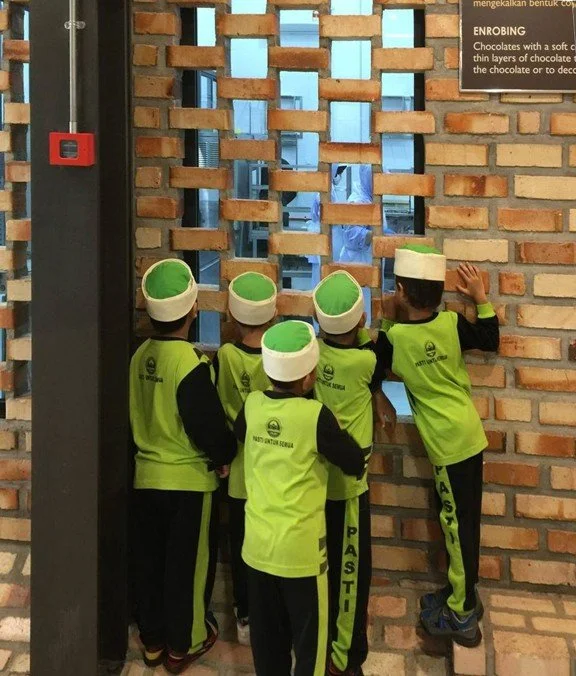
Beryl's Visitor Centre, Serdang: children at the perforated brick wall
Architecture does not end at the building; it contributes to the identity of a place. Beryl's Visitor Centre in Serdang is a commercial building. It sells chocolate. But where the mall is designed to make visitors forget why they came, we asked what would happen if a commercial building made people more curious rather than less aware.
So the chocolate-making is not hidden. Children peer through perforated brick walls into the process. Visitors gather beneath trees, linger in the exhibitions and sit together. Nobody instructed those children to look; the wall invited them. A building occupies land. A place occupies memory.
From Hiding to Revealing
Matter: Conceals structure > Shows how it stands
Climate: Seals the tropics out > Filters them in
Space: Prescribes activities > Permits lives not yet imagined
Culture: Instructs where to gather > Invites gathering
Time: Pretends to stay new > Grows and deserves care
Place: Consumption that makes us forget > Encounter that makes us remember
At every point the building still has authority. What changes is direction. And on the right, the authority does not come from the architect. It comes from the brick, the wind, the sky, the family, the years and the community. The architect borrows it from the place and returns it to the people who live there.
Beyond Sustainability
Sustainability has changed our profession for the better, and the work of reducing energy, waste and carbon remains urgent. But sustainability tells us how buildings perform, and far less about how they are inhabited. A building can meet every benchmark and still keep its occupants unconscious of where they are.
Sustainability seeks to reduce harm. Tropical Intelligence seeks to deepen relationships: between people and materials, climate, space, one another, time and place. Sustainability teaches us to build more responsibly. Tropical Intelligence asks us to build more wisely.
Four questions
To every young architect, I offer four questions to ask of every project:
What will this make people notice? Not what it will make them do, but what it will make them notice: the light, the rain, the material, each other.
Whose authority am I exercising? Mine, the client's, the market's, or the place's?
Can it be read, and can it be declined? If not, it is an instruction, not an invitation.
Will it still deserve care in twenty-five years? Not merely survive, but deserve care.
No rendering can answer these. The answers come only from listening: to the site, to the craftsmen, to the people who will live there, and to the tropics themselves.
The Conscious Horizon
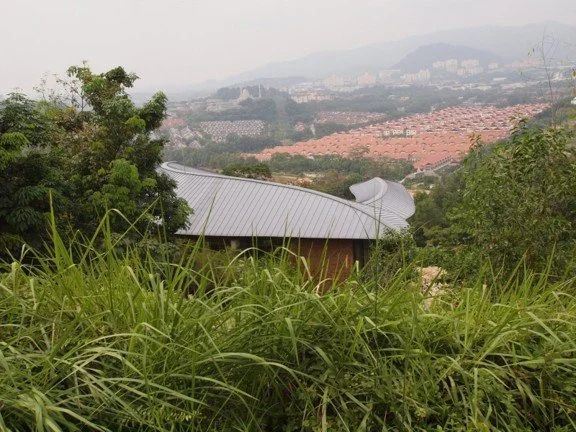
Ting Residence, Country Heights Damansara
At Ting Residence in Country Heights Damansara, a leaf-shaped roof settles into the hillside, with the city stretched along the horizon beyond.
The conscious horizon is not a line we draw. It is the line where the world begins to be noticed. Architecture always works at that line. It can push people beneath it, into habit, consumption and forgetfulness, or it can lift the world above it: the sky, the rain, the hand, the neighbour, the years.
Architecture is a quiet authority. Let us make it a generous one. The tropics have always been intelligent. Our task is to listen carefully enough to turn that intelligence into places where people, nature and time can flourish together.
References: Churchill, House of Commons, 28 October 1943 (Hansard); Jeremy Bentham, Panopticon (1791); Michel Foucault, Discipline and Punish (1975); Bai Juyi, Record of the Thatched Hall on Mount Lu, trans. Burton Watson; Lim Jee Yuan, The Malay House (1987).